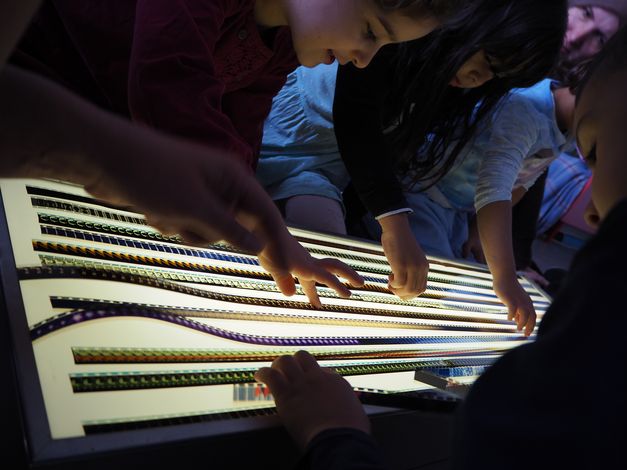
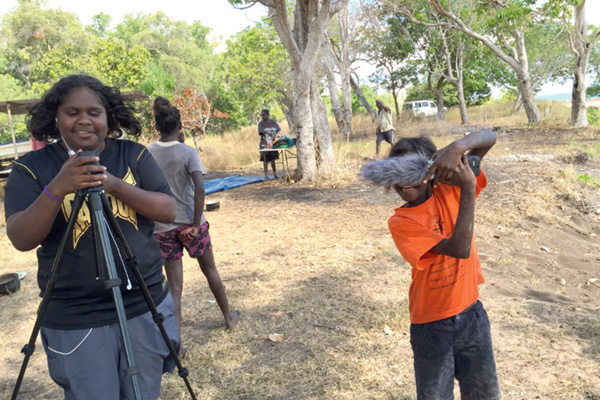
Stefanie Schlüter invites schoolchildren to Arsenal with her "Living Archive for children, with children" project. What can a film archive do, what can films do for the aesthetic and cultural edcuation of young people growing up in the digital age? The center of her project, which is primarily directed at elementary pupils, is the Arsenal's comprehensive collection of experimental films. These can confront the viewer with an unusual view of things, they are often playful in form and deal with questions of perception at the intersection between film and other arts.
From October 10-14, Arsenal is organizing an international congress for the very first time, in collaboration with the Film Institute at the Berlin University of the Arts. Think:Film, the International Experimental Cinema Congress 2012, is taking place at the Akademie der Künste on Hanseatenweg with the goal of examining the special position occupied by experimental cinema in contemporary artistic and intellectual practice in philosophical terms and redefining just what this position might be. Fifteen panels over five days bring together international filmmakers, artists, film and arts scholars, authors and curators, who will jointly be exploring questions relating to the influence of the cinematic image on today’s thought and discussing how cinema itself can become an act of thought. Rather than grasping experimental film a definitive genre, the congress seeks instead to pose some fundamental questions, many of which go beyond the central theme of how film and thought influence one another (such as how film itself can be understood as theory) to encompass the institutionalization of the cinematic image, the relationship between acting, performance, the stage and film, film as a means of political practice, the production and distribution of today's experimental cinema and the current status of such terms as "underground" and "avant-garde". A screening of Isidore Isou's film TRAITE DE BAVE ET D'ETERNITE (France 1951, 10.10.) opens Think:Film.
From October 19–21, the Documentary Film Initiative of the Filmbüro NRW (dfi) is organizing a symposium at the Academy of Media Arts Cologne on "Documentary Methods in Art". Stefanie Schulte Strathaus is giving a presentation there on October 20 entitled "Distribution and Discourse: Experiments in Cinemas and Exhibition Spaces". Further participants include Christa Blümlinger, Phil Collins, Barbara Engelbach, Luke Fowler, Ulrike Franke / Michael Loeken, Philipp Hamann, Dietrich Leder, Mischa Leinkauf, Katrin Mundt, Marcel Odenbach und Fiona Tan.
As part of REVOLVER magazine’s HANDS ON FASSBINDER series, a discussion with the artistic directors of Arsenal, Stefanie Schulte Strathaus, Birgit Kohler und Milena Gregor, is being held this Saturday (15.9.). They will be talking to Christoph Hochhäusler and Ekkehard Knörer about the tasks, challenges, conditions, goals and contradictions that go hand in hand with an institution which is not only Berlin’s most important cinema and one of the most well-known film organizations in Europe, but is also active in the fields of distribution, archival work and, in the form of the Berlinale Forum, curation.
The fourth edition of the Arsenal Summer School is taking place from August 23 to 25 entitled WILD THOUGHT / THINKING WILD. EXPERIMENTAL FILM AS A METHODOLOGY. In a series of eight events, including studio and film discussions, debates and screenings, speakers from practical and theoretical backgrounds will be contemplating experimental forms as the expression of a vision of cinema in relation to the world. The subject of this year’s Arsenal Summer School also functions as a lead-in to the "Think:Film" conference taking place in October.
How do avant-garde and experimental films come into the archive – and then back into the public sphere? Often having come about in unconventional ways and long perceived to be on the edge of film history, these films usually only find their way into an archive because of the personal commitment of individual collectors. Once there, they often put the standard strategies of archives into question: How does one describe works whose contents are not conventional? What rules of conservation should be set for material which does not have a negative as an original? How do films which have their own materiality as a theme be appropriately restored? Four international collections – the Academy Film Archive in Los Angeles, the EYE Film Institute in Amsterdam, the Deutsche Kinemathek, as well as Arsenal – Institute for Film und Video Art – are presenting their avant-garde collections and discussing the challenges and perspectives when dealing with such films. Daniel Meiller (Deutsche Kinemathek), Simona Monizza (EYE Film Institute), Mark Toscano (Academy Film Archive) and Stefanie Schulte Strathaus (Arsenal) will explain what archiving and digitalization strategies are possible and introduce concepts for bringing the undiscovered to the surface. This year's parallel children's colloquium, for children aged between eight and 14, is also about how to raise awareness about archive work and avant-garde films.
What can a cinema, a film archive and films accomplish when it comes to the aesthetic and cultural education of young people who have grown up in the digital age? This is one of the many questions that Stefanie Schlüter is exploring as part of her "Living Archive" project. To this end, she will be opening the doors of the Arsenal film archive on May 21 from 3pm to 6pm to teachers from all types of school and of all age groups.
This program comprises a group tour around the archive rooms themselves and the screening of short films chosen collectively. Teachers are invited to browse through the archive, which houses over 10,000 films and videos. In the second part of the program, Stefanie Schlüter will then present the different opportunities the Arsenal archive offers to teachers in order that questions about the past, present and future of the moving image can be developed together with students.
To coincide with the children's exhibition at the Deutsche Kinemathek on the theme “Heroes” we are presenting fitting films on each last Sunday of a month. On May 27, the Danish film HODDER SAVES THE WORLD! (En som Hodder, Henrik Ruben Genz, 2004) will be showing, in which a fairy confronts a nine-year-old with a request which he can't refuse. Young heroes that present the "Hero ticket" from the exhibition will receive free entry.
The maxim of our What is cinema? programon April 20 for high school students is: "Listen up!". It is all about sound in the cinema – from the first sound attempts of early film to modern experimental sound design.
A season to accompany a children's exhibition about heroes on the 4th floor of the cinema begins on 29 April. WE CAN BE HEROES! (Bäst i Sverige!, Ulf Malmros, Schweden 2003) is about Marcello und Fatima who both want something very different from their parents.
This month's "What is Cinema?"-jour fixe on March 16 is all about animals: Animals in films free the gaze. This was clear in the first film in the history of cinema when a dog suddenly walked through the entrance gate between the workers leaving the factory. Animals have been turning up on screen in all sorts of ways since then, either randomly or as main protagonists in documentaries or features, experimental or animated films. Animals can serve to reawaken the interest of a viewer, either when a cat masters its role perfectly or Indian cows amid dense traffic impart a sense of complete calm. This program takes a little foray into film history and shows animals from different and often surprising angles. (Stefanie Schlüter) The program is aimed at schoolchildren in classes 1 to 6.
All of the programs of last year's jour fixe screening period for our film education program "What is Cinema?" are now available for booking. The jour fixe series is being continued since the start of the new School year in September 2011.