Béla Tarr in memoriam

Béla Tarr, a frequent guest at Arsenal and the Berlinale Forum, passed away on January 6. In commemoration of the visionary filmmaker, from March there will be a rare opportunity to watch two of his films in the movie theater: SÁTÁNTANGÓ and WERCKMEISTER HARMONIAK. The screenings at Cinema Paris and delphi LUX will be accompanied by introductions and discussions.
Béla Tarr in memoriam is a project by Joachim von Vietinghoff, in cooperation with the Deutsche Kinemathek and the Arsenal Institute for Film. Yorck-Kino GmbH has organized the screenings.
Ulrich Gregor on Béla Tarr:
Béla Tarr (1955-2026)
Béla Tarr was not only a master of film history and contemporary world cinema but also a friend of ours. He was a frequent guest at Arsenal and the Berlinale. His death is an irreplaceable loss for us and for all film lovers.
Béla Tarr accompanied our work from the 1970s, when we traveled to the countries of the Eastern Bloc in search of films for our festival, the International Forum of New Cinema. We came across a very lively film scene in Hungary, and the works of Béla Tarr, which even then struck a completely new note in Hungarian cinema.
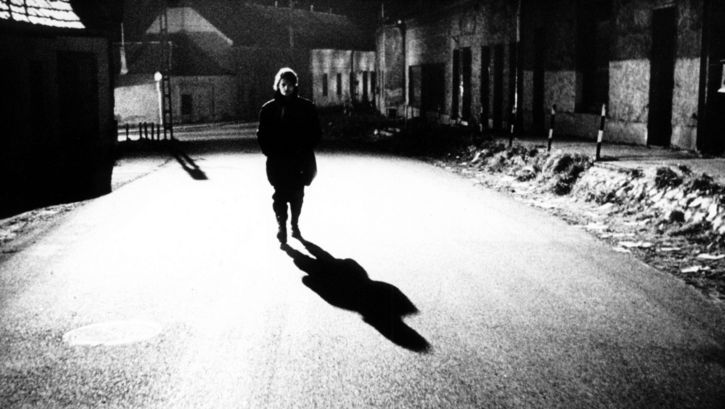
The first Béla Tarr film that we showed in the Forum was "Damnation" ("Kahorzat", 1988). What fascinated us about this film were the long takes (or “plan sequences” in French, a stylistic device that Béla Tarr would remain faithful to until his last film), the pervasive gloom, the underlying metaphorical level of the plot, and there were already sequences that left an unforgettable impression.
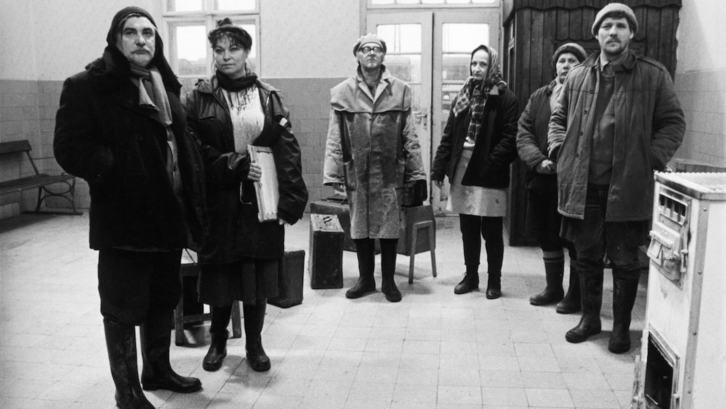
This was followed in 1994 by one of the greatest cinematic masterpieces, “Sátántangó”, a 7-hour-and-16-minute-long adaptation of a novel by Laszlo Krasznahorkai. It is a parable about false prophets and the decline of humanity. It features scenes, long takes, that can be described as unforgettable: the opening sequence, in which cows leave their shed and cross a seemingly endless muddy plain, or the scene in a bar with endlessly looping accordion music.
We were able to watch a working copy of "Sátántangó” in Budapest; the sound was still separate, and after each reel there was a break, during which we could refresh ourselves, drink coffee and chat. This is how we spent a whole day watching this film. Even then, it seemed to me that it was the best way to watch such a film as "Sátántangó”. Not long ago, for an anniversary, Béla Tarr requested a new screening of the film at the Delphi cinema, with an introduction and discussion, just like during the 1994 Forum.
One of the characteristics of Béla Tarr's films is that their substance and crystallize in images and sequences of images, rather than in plot developments or dialogues. This is also the case for "Sátántangó”, in whose final sequence we see a window being boarded up piece by piece from the inside. There is no other film that involves the viewer so strongly in the action, drawing them into a world, from which there seems to be no escape. This is Béla Tarr's dark but concise and idiosyncratic worldview, which provides something like a condensed depiction of the state of humanity. Béla Tarr's last film, “The Turin Horse,” shot in 2011, following “Werckmeister Harmonies" (2000) and “The Man from London” (2007), goes one step further in its radicalism. It forces viewers to reflect on themselves and the state of the world, on the past and future, on death and the end of civilization.
Where does Bela Tarr's work take us, what perspectives does it open up for us?
What remains is the example of uncompromising artistic work that Béla Tarr provides with his films. This is the formal rigor of his films, their visual concentration and density, their radicalism in expressing a finding about the state of humanity, “la condition humaine.
Béla Tarr does not deliver just any kind of message. But his films are crystal-clear and cohesive artistic constructions, so that his oeuvre, with its distinctive style and its thrilling and perfect form, presents an alternative to the otherwise gloomy picture of our world.
Ulrich Gregor
Funded by: