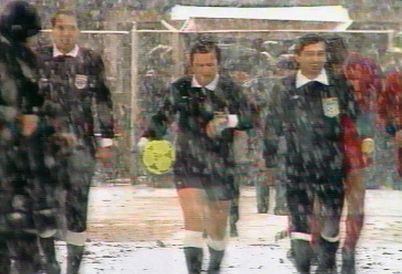
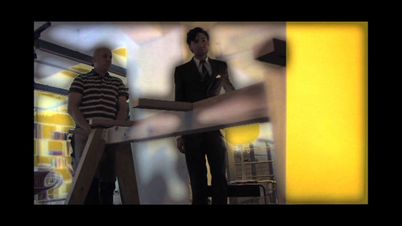
A deceptively simple set-up: the director and his father watch a 1988 football match which the father refereed, their commentary accompanying the original television images in real time. A Bucharest derby between the country’s leading teams, Dinamo and Steaua, taking place in heavy snow, one year before the revolution that toppled Ceaușescu. The conditions are difficult at best, the play hardly sparkling. One match among many, the standard game of two halves, yellow intertitles marking time and grainy video images which merge with the snow: the perfectly unspectacular basis for a foray into the conditional. What if the ball hadn’t hit the crossbar? What if the referee had bowed to pressure and favoured one team? What if the camera had actually shown the brief ruckus on the pitch? What if the match had taken place one year later? What if snow had stopped the game from taking place at all? An endless chain of imaginary second games spiralling off from the first, each with different images, different scorelines, different allegiances, and different significances. If you were to ask which football game says the most about everything, I would tell you it is the one which is most banal. (James Lattimer, Forum catalogue)
Magical History Tour - City Symphonies
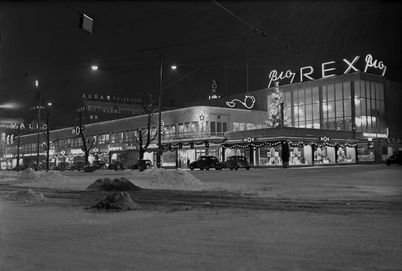
BERLIN. DIE SINFONIE DER GROSSSTADT (D 1927) is not only a singular portrait of the dazzling metropolis in the mid-1920s but also the linchpin of an eponymous series of short and long documentaries from the 1920s and 30s. The city symphonies employed rhythmic montage and associative sequences of images to capture the increasing dynamism, mechanization and modernity of cities. Rhythm, tempo, movement, abstraction and the joy of experimenting shaped these filmic approaches to Berlin, Nice, Moscow, New York and Paris. Those we are showing in June are taken from across film history and include specimens which revere the first city symphonies as well as distant echoes of the early cinematic urban explorations.
The DEFA Foundation Presents
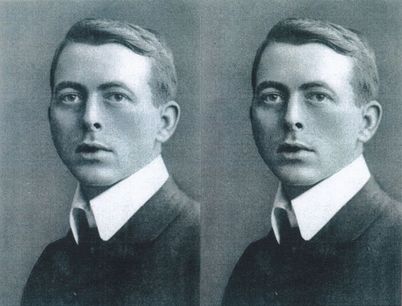
UdK-Seminar: Double Images
"Berlin Telegram"
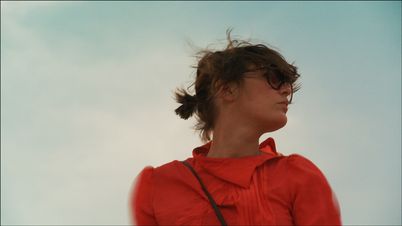
Leila is a singer-songwriter who lives in Brussels. When Antoine, the man she is in love with, suddenly walks out on her for another woman, she leaves for Berlin to start a new life. Before closing the door of her apartment for the last time, she films herself in a mirror, vowing, one day, to send Antoine the images of her new life. It will be her revenge. It's a musical road-movie that travels to Brussels, Berlin, Lisbon and Cairo with Leila as our guide . A story of crossing paths, re-learning to live, and opening yourself up to the world. Antoine will never get to see the images.
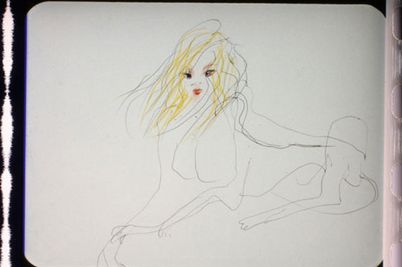
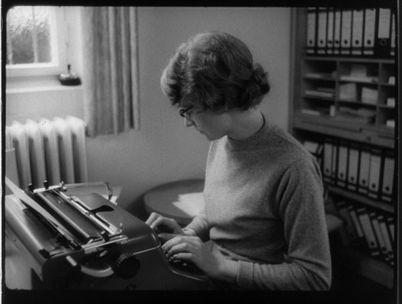
Michel Leiner died on 16. March 2014 in Frankfurt am Main. In his memory, Bärbel Freund and Anne Grèzes are presenting WALDI (Reinhard Kahn/Michel Leiner, BRD 1979/80) on June 16. "Robert Walser's "Der Wald", a piece of prose that feigns to be a school essay, which first appeared in a Bern Sunday newspaper in 1903, is the object of this film which intimately and lovingly campaigns for its cause and is wrapped in a flowing lustrous green." (Peter Nau) GENÈSE D’UN REPAS (Genesis of a Meal, Luc Moullet, F 1978) is a comparative economic study about a Senegalese tin of tuna, a French egg, a banana from Ecuador, and about film material from its manufacture to its exploitation.
Filmspotting. Exploring the Deutsche Kinemathek’s Film Archive
"Sieniawka"
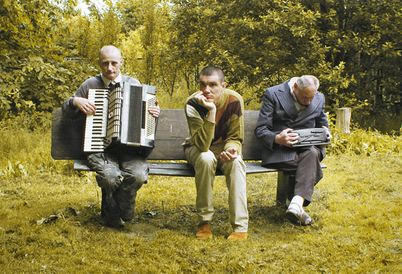
In an unreal age, in a landscape scarred by open-cast coal mining, people still live; old men, their faces marked by deep lines. A cosmonaut in a weather-worn boiler-suit inspects the plundered earth: future, past and present come together in SIENIAWKA, a film of few words. The men in the "outside world" live in the "freedom" of a zone that bears the geographical, political and film historical marks of an apocalyptic present. Other men have fled to the "inner world" of an institution, surrendering in resignation to rigid everyday routine. They wear gloomy pullovers and slippers, their soup is served in buckets, and they smoke together at the open window. But at some point summer has come and the light streaming through the birch trees is dazzlingly bright, full of promise. How real can life be in a place forgotten by history? Sieniawka is a small village in the border zone between Poland, Germany and the Czech Republic, a place known for its checkpoint and local psychiatric clinic. Life on an alien planet, barely an hour’s drive from Berlin. (Dorothee Wenner)