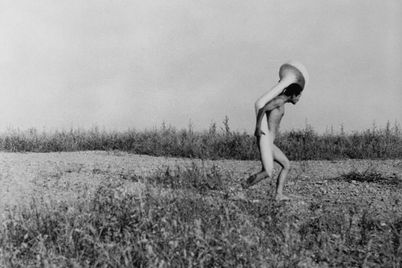
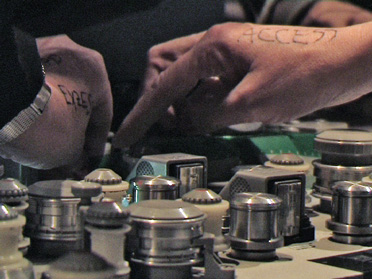
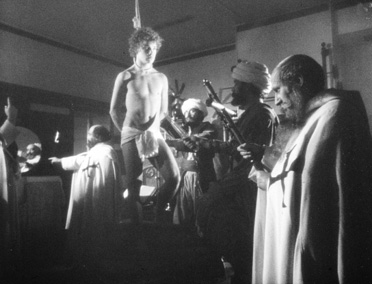
In February 2012, students from Hito Steyerl's class at the UdK Berlin organized the exhibition Now! (Extended): A Copy in Motion at Kunstraum Kreuzberg. It featured cinematographic, installative, performative and sculptural works which examined Santiago Álvarez's NOW! (Cuba 1965), a found-footage film made up of photos of the US 1960s civil rights movement, and asked how relevant the film is in a digital era in which images and sounds are becoming increasingly mobile and their appropriation and piracy are daily occurrences. In June, the students will show an installative documentary of the exhibition at the KW and present a book about the project (Performing Books, KW, 19.6.). There will also be film performances at Arsenal (22.6.).
Trust the filmmakers, or trust those who you trust and they trust the filmmakers (Ala Younis)
Text and visual notes from and about the films of the archive and the issues that made us pause during our research. A film evening featuring excerpts of films that are the basis of an ongoing publication project, which treats the films themselves as protagonists, which describe geographical and temporal paths and not only thus enable us to interpret their less known characteristics but also the moment of arrival. What does it mean to come across these films as an explorer? The publication will be produced in Cairo as a "Cahier de la Cimatheque". Excerpts can be seen at KW. (22.6.)
Numerous publications are being published in the context of the Living Archive project. In adition to the Living Archive catalogue, "Rising Stars, Falling Stars", a broshure accompanying Vaginal Davis' series at the Arsenal cinema has already been published as well as eleven books within the framework of the project "KEYwording". The publication "NOW! Extended" will be available soon. Madhusree Dutta and Ines Shaber’s project "KEYwording – Notes on Enculturation of Words and Word Practice within the Image Archive" deals with the importance of tagging and annotation for the functioning of an archive. The Arsenal has abandoned the convention of keywording because "the given categories do not and cannot be applied to many of the films Arsenal is collecting." Inspired by this statement, the project aims to create a cross-cultural dialogue on the usage of words and their expanses in the context of myriad theories, practices, associations and actions within the field of cultural productions.
George Brecht's contribution to George Maciunas' 1965 FLUXREEL shows for 8 minutes a monochrome image that is white to begin with and gradually gets darker. When the screen is black, the eyes get used to the darkness and the viewer's gaze wanders. The materiality of the screen can be recognized. The surroundings return. An open air screening at KW Institute for Contemporary Art. (22.6.)
Dorothy Arzner ate chili con carne at the Arsenal cafe (and other stories)
They attended each public screening throughout the duration of the project: Erika and Ulrich Gregor and their stories. Each phase of Arsenal's history had its own protagonists, each one of them recounts other memories of single films, of the institution's inner life, of battles against the outside world. An institution lives on hearsay – it's what lends it an independent life in the public sphere, but it also draws on the nuances in between. Facts, friendships and films; this event is about everything. There will be employees from all phases of Arsenal's history on the panel to answer the audience's questions. (23.6.)
What can I see when I have a filmstrip in my hands. How do I find a film in the archive? Which pictures remain with me after a program of shorts? Over 200 Berlin schoolchildren were able to gain an insight into Arsenal's film collection. They curated their own programs from short, mainly experimental, films in a playful way. They also drew their recollections of films. Stefanie Schlüter presents the results in an exhibition and three events for families and schools. Films, programs and drawings made by the children will be shown. They will also provide live scores. The project was supported by the filmmakers Ute Aurand, Robert Beavers, Milena Gierke and the silent movie pianist Eunice Martins. (For children aged 6 and above, 9.–13.6.)
Living Archive for Children, with Children
What can I see when I have a filmstrip in my hands. How do I find a film in the archive? Which pictures remain with me after a program of shorts? Over 200 Berlin schoolchildren were able to gain an insight into Arsenal's film collection. They curated their own programs from short, mainly experimental, films in a playful way. They also drew their recollections of films. Stefanie Schlüter presents the results in an exhibition and three events for families and schools. Films, programs and drawings made by the children will be shown. They will also provide live scores. The project was supported by the filmmakers Ute Aurand, Robert Beavers, Milena Gierke and the silent movie pianist Eunice Martins. (For children aged 6 and above, 9.–13.6.)
Living Archive Publications
Numerous publications are being published in the context of the Living Archive project. In adition to the Living Archive catalogue, "Rising Stars, Falling Stars", a broshure accompanying Vaginal Davis' series at the Arsenal cinema has already been published as well as eleven books within the framework of the project "KEYwording". The publication "NOW! Extended" will be available soon. Madhusree Dutta and Ines Shaber’s project "KEYwording – Notes on Enculturation of Words and Word Practice within the Image Archive" deals with the importance of tagging and annotation for the functioning of an archive. The Arsenal has abandoned the convention of keywording because "the given categories do not and cannot be applied to many of the films Arsenal is collecting." Inspired by this statement, the project aims to create a cross-cultural dialogue on the usage of words and their expanses in the context of myriad theories, practices, associations and actions within the field of cultural productions.
Film archeology (Sabine Nessel)
The "Kinoarchäologie" project features eight films by the American documentary filmmaker Les Blank. WERNER HERZOG EATS HIS SHOE (USA 1980), the starting point for a film archeology project undertaken by students at the FU under Sabine Nessel's direction, will open the program as a cinematographic counterpart to the group's contribution to the exhibition. Les Blank's films show the variety of everyday life, food, music and immigration culture in the US in a specifically subjective way, with single people, subjects or places returning again and again. The films bring his work with Maureen Gosling and Skip Gerson to the fore, as well as blues, zydeco, Creole and Cajun food traditions and musical cultures. We will be screening other films by Les Blank in July. (27. & 28.6.)
Film Without Film (Martin Ebner)
"Film without film" is the title of a series of chain-like wooden and plastic objects of different lengths and sizes which take their individual structure and color patterns from the patterns and scenes of experimental films from the 1960s and 70s that are in the Arsenal archive. They act like proxies of the films, there is recognition. In the exhibition, they lie around randomly, like sleeping animals. They can be observed and compared; people can imagine what's going on with them. In principle, they could also be deconstructed, carried around, combined and if one so wanted one could build new objects out of them, give them new names, new imaginary films whose idea would be once again be collected at another place, archived, attended to, described, sold, given away, lent... (KW)
Funded by:
Arsenal on Location is funded by the Capital Cultural Fund
The international programs of Arsenal on Location are a cooperation with the Goethe-Institut