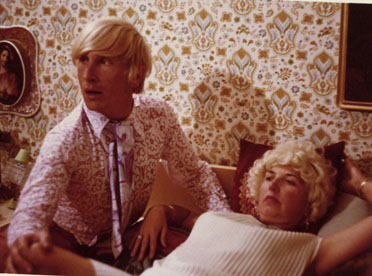
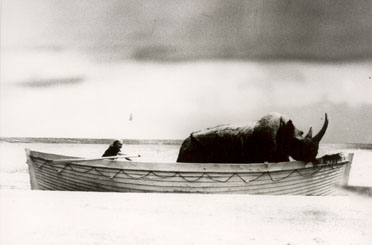
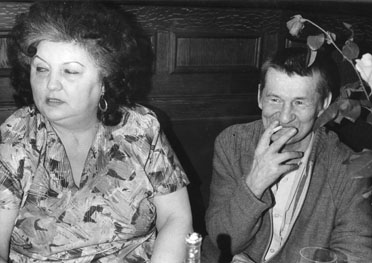
On Novmeber 19, Stefan Hayn will be presenting MOSES UND ARON (West Germany 1974) by Danièle Huillet and Jean-Marie Straub and HUNDERT BLATT SCHREIBBLOCK (BRD 1969) by Vlado Kristl – the short film is also in memory of Carola Regnier, who loved Kristl’s works, knew how to read his poems and lived with his paintings. Kristl went from painting to film, from Yugoslavia to West Germany, where he then tried to paint his way back out of the cinema. He drew one of the posters for MOSES UND ARON.
Guest: Christian von Borries
Dubai and Neverland mark places at which the world of dreams and reality flow into one another and the distance between reality and representation dwindles. Filmmaker Christian von Borries (*1961) explores how this phenomenon expresses societal processes in his two documentary essay films, both of which move beyond classic documentary forms. In THE DUBAI IN ME – RENDERING THE WORLD (Germany 2010), the business city of Dubai and its function as a theoretical undertaking and artificial paradise is the focus, as is the real estate association which operates in the guise of a state. MOCRACY – NEVERLAND IN ME (Germany 2012) is a collage of internet and TV clips which examines consumerism, capitalism, companies, architecture and the "charity industry" in Kazakhstan, Kosovo, Pyongyang, Detroit and Berlin. Michael Jackson meets Angelina Jolie meets Jean-Luc Godard. A political pamphlet on the pop sound of the 80s. (1.11.)
On November 8 two films from 1973, stemming from different production contexts – Chile and West Germany –, will be screened and discussed at the request of Florian Wüst: Carlos Flores del Pino's DESCOMEDIDOS Y CHASCONES and TEILWEISE VON MIR – EIN VOLKSSTÜCK by Hellmuth Costard.
43rd Berlinale Forum
Submissions for the upcoming Berlinale Forum are closed now. The festival will take place from February 7 - 17, 2013.
Exercises in Balance: Commemorating Rolf Richter's 80th Birthday – Films, Texts and Collages
At the end of October, we would like to remember screenwriter, film critic, poet and artist Rolf Richter (1932–1992). As a scriptwriter and co-director, he shot numerous DEFA documentaries with Eduard Schreiber and other filmmakers. He was one of East Germany's most important film journalists and became editor (together with Erika Richter) of the East Germany film magazine Film und Fernsehen in 1992 after it was left without an owner. From the end of 1989, Richter headed the commission for the rehabilitation and re-release of the banned DEFA films from 1965/66. In the period of reunification, he fought for the Babylon cinema to be kept open and gave it a new profile in the form of the Berliner Filmkunsthaus Babylon. Hans-Jörg Rother called him "an out-on-a-limb maverick of the real socialist film scene before reunification and a driving force for the preservation of the East German cinema landscape"; "His thoughts revolved (...) around the internal aspects of society, whose end he had seen coming and whose residues in consciousness should not fall victim to new repression."
Think:Film - International Experimental Cinema Congress 2012
From October 10-14, Arsenal is organizing an international congress for the very first time, in collaboration with the Film Institute at the Berlin University of the Arts. Think:Film, the International Experimental Cinema Congress 2012, is taking place at the Akademie der Künste on Hanseatenweg with the goal of examining the special position occupied by experimental cinema in contemporary artistic and intellectual practice in philosophical terms and redefining just what this position might be. Fifteen panels over five days bring together international filmmakers, artists, film and arts scholars, authors and curators, who will jointly be exploring questions relating to the influence of the cinematic image on today’s thought and discussing how cinema itself can become an act of thought. Rather than grasping experimental film a definitive genre, the congress seeks instead to pose some fundamental questions, many of which go beyond the central theme of how film and thought influence one another (such as how film itself can be understood as theory) to encompass the institutionalization of the cinematic image, the relationship between acting, performance, the stage and film, film as a means of political practice, the production and distribution of today's experimental cinema and the current status of such terms as "underground" and "avant-garde". A screening of Isidore Isou's film TRAITE DE BAVE ET D'ETERNITE (France 1951, 10.10.) opens Think:Film.
Think:Film Warm-up Screenings
In the lead-up to Think:Film, we are offering audiences the chance to get to know the work of some of the congress participants. On 7.10, LaborBerlin, the independent film laboratory in Stattbad Wedding, presents the results of the "Analogue Zone" workshop, the first part of which took place in Cairo. Four Egyptian workshop participants are in Berlin in October to learn more about working with analogue film material in the laboratory here. LaborBerlin’s Cairo partner is Cimateque, a center for independent filmmaking co-founded by Tamer El-Said and Khalid Abdalla, both of whom are panelists at the Think:Film congress. Following the workshop presentation, there is the rare chance to see the Egyptian-Italian experimental film SUMMER 70 by Nagy Shaker and Paolo Isaja, "a meditation on freedom at the turn of the 1970s that utilizes the full vocabulary of experimental cinema" (MoMA). Nagy Shaker will be attending the discussion.
Retrospective Marco Bellocchio
Marco Bellocchio (*1939) is one of Italy's most important and prolific filmmakers. Since his furious debut I PUGNI IN TASCA (Fists in the Pocket), which established him in the mid 1960s as a leading representative of contemporary Italian cinema, he has directed nearly 50 shorts, features and documentaries. His hugely multi-faceted oeuvre encompasses vehement direct attacks on the bourgeois institutions of the family, the state and the church, uncompromising indictments of power structures and relations in politics, the media and society, complex, introspective studies of the emotionally damaged, cinematic examinations of psychological processes, appropriations of literary sources and precise documentary works, Often seen as a tireless wanderer between a wide range of different genres, subjects and forms of production and a experimenter and communicator of concepts, Bellocchio's work confronts us with anarchy and rebellion, desire and passion, the subconscious, the world of dreams and the realm of the shades. In doing so, he places the mental state of his protagonists – rebels, dreamers and outsiders played by outstanding actors such as Lou Castel, Laura Betti, Sergio Castellitto, Giovanna Mezzogiorno, to name just a few – in direct relationship with their surroundings, connecting the private and the public, and allowing the personal to coalesce with the flow of historical and political time. Yet Bellocchio doesn't just bring together different narratives or layer them on top of one another in individual films, but also allows characters, locations, moods and ideas from the various films made over his decade-long career to enter into dialogue with one another. Discovering the delicate connecting lines that criss-cross Marco Bellocchio's impressive oeuvre is just one of the many delights that we and the Italian Cultural Institute invite you to partake in this October. We are particularly happy to be able to welcome Marco Bellocchio to Arsenal on October 5 and 6 to present his latest film BELLA ADDORMENTATA (2012), which received its world premiere just days before we went to press, as well as his first feature length work I PUGNI IN TASCA.
Public screening on October 18
Funded by:
Arsenal on Location is funded by the Capital Cultural Fund
The international programs of Arsenal on Location are a cooperation with the Goethe-Institut