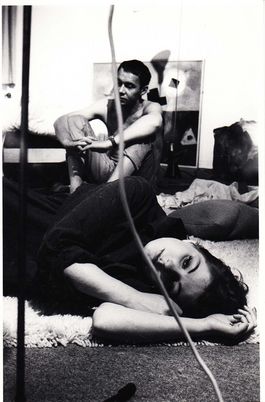
As our contribution to the 7th Polish film festival in Berlin – filmPOLSKA – which is taking place from 12. to 18. April in different cinemas in the capital and Potsdam, we at Arsenal are putting the spotlight on Polish camera operators for the third time running. This year, we are pleased to welcome Bogdan Dziworski and Wojciech Staroń, who will each present their camera and directing work on two evenings. Bogdan Dziworski, who has made well over 40 films, started working as a cameraman and photographer in the mid-1960s, and soon afterwards started directing too. He focuses particularly on documentary in his work, and in the 1970s and 80s, he made films for the renowned Wytwórnia Filmów Oświatowych (Educational Film Studio) in Łódź. He also later worked as a cameraman for a BBC series of films about the former Soviet Union. His photographs have received great acclaim in a series of exhibitions and publications. Dziworski always has a number of projects on the go at once and is also the dean of Radio & TV department of the University of Silesia in Katowice.
Following Entuziazm’s proposal we will be screening SHIWJOT TAKOJ PAREN (Wassilij Schukschin, UdSSR 1964) on April 17th at 7 pm. The film was screened, in addition to three further films by Schukschin, at the International Forum of New Cinema in 1978. In 1964 the film was honored with a Golden Lion at the Mostra in Venice.
Remembrance and Future Award for "Revision"
REVISION by Philip Scheffner has received the 'Remembrance and Future' Award at goEast Film Festival in Wiesbaden. The film, which was shown in this year's Forum program, reconstructs the circumstances which led to the death of Grigore Velcu and Eudache Calderar in a field near the German-Polish border in 1992, which have not been clarified until today. According to official reports, they were victims of a hunting accident, a tragic mix-up over wild boar. The hunters were never convicted, as the protracted trial failed to pursue many of the most decisive questions and eventually ended in an acquittal. Nearly 20 years later, Philip Scheffner carries out the painstaking investigation that never took place back then. He seeks out the dead men’s relatives in Romania and records the statements they were unable to give until now. As with the other witnesses and different experts he returns to question, he gives them the opportunity to listen to their own statements and reassess them as necessary – unlike standard practice, which elevates statements to fact the very moment they are made. In this way, Scheffner performs a cinematic revision of the case and the medium simultaneously. His diligent handling of material and reports creates a web of landscapes, recollections, case files and German political sentiment all of an increasingly oppressive complexity.
Working Environments in Film
We are accompanying a seminar given by Ulrike Vedder and Alexandra Tacke at the Humboldt University on Working Environments in Literature and Film with a film series that will continue in June and July. The focus of the series are films which observe the upheavals in the world of work, looking at the 20s and 30s on the one hand and the last few years on the other.
Why do we use a camera? Are we researching the social sphere as Robert Flaherty once suggested to Joris Ivens? In CINEMAFIA, Jean Rouch, Joris Ivens and Henri Storck talk about these matters. Other films that deal with these questions are Jean Rouch’s PAM KUSO KAR about rituals in Niger and PAS TOUT by Isabelle Prim and Ludovic Burel, a "family film" that takes place in an abandoned factory. From 1968 to 1970, the Medvedkin Groups used strategies to treat political experiences in a cine-matic manner. LES TROIS QUARTS DE LA VIE was shot by young employees at a Peugeot factory. They received support from Chris Marker and Bruno Muel. (Eléonore de Montesquiou)
Vaginal Davis' New Series: Rising Stars, Falling Stars – We Must Have Music!
Vaginal Davis has spoilt her audiences with silent movies and live music over 40 times. Now she asks: "Is there a new way of seeing music in film?" and launches into a new Arsenal series about film and music. Once a month, the "curatorial mother" will personally present a film and then invite the audience to drinks and music after the screening. Although her selection comprises all periods and genres, they are all from the Arsenal collection – Vaginal Davis is a participant in the "Living Archive" project (p.23). Her opening film is Otto Preminger's PORGY AND BESS (USA 1959), a film version of the eponymous opera by George Gershwin, starring Sidney Poitier, Dorothy Dandridge, Sammy Davis Jr., Pearl Bailey, Brock Peters and Diahann Carroll. (22.4.)
Magical History Tour: Shadows, ghosts and doppelgängers
The ephemeral, eerie and uncanny nature of film finds its coherent but equally unstable shape in the fleeting form of shadows, ghosts and doppelgängers. Ghosts of history, cultures and myths, shadows – from those that are cut out of paper to those created by moonlight – the protagonists’ dark sides that are often brought to light by the figure of the doppelgänger, all foretell the uncanny, the strange, and indeed the shudder, as the original principle of cinema. This month’s Magical History Tour invites viewers to 11 different encounters in the dark cinema with restless ghosts, illusionary shadows and doppelgängers unleashed.
Camp/Anti-Camp: Tropicamp & Jack Smith, Tropicana, Kuchar & Warhol
In April, we continue a season to prepare ourselves for the "Camp / Anti-Camp: A Queer Guide to Everyday Life" festival (19.–21. April, HAU) curated by Susanne Sachsse and Marc Siegel. The academic Max Jorge Hinderer Cruz has designated Tropicamp as one of the festival's main focuses. The term, which was coined by Brazilian artist Hélio Oiticica to express his fascination for the anti-commercial trends in the US' underground movie scene (especially in the works of Mario Montez and Jack Smith), will shed an international light on the camp debate. In the "What is Tropicamp" program, Hinderer Cruz and Marc Siegel will juxtapose film clips from the Brazilian Tropicalía movement (e.g. Oiticica, Ivan Cardoso) with excerpts from American underground movies. (3.4.)
Cinema for children and youths
arsenal distribution @ Oberhausen
This year arsenal distribution again presents a special program at the film market of the 58th International Short Film Festival Oberhausen. On Sunday April 29, SONG FOR RENT (USA 1969) and JUNGLE ISLAND (USA 1967) by Jack Smith will be shown as well as a selection of films from this year's Forum Expanded program: Jennifer Rainsford and Virlani Hallberg's O.G.B.I.P. [Our Global Behaviour Is Psychopathic I] (Sweden 2011), Fern Silva's PERIL OF THE ANTILLES (USA / Haiti 2011), THE CONDITION OF THE WORKING CLASS IN ENGLAND – LITTLE IRELAND. 1842/2011by Rainer Ganahl and T.S.T.L. by Gheith Al-Amine.
Funded by:
Arsenal on Location is funded by the Capital Cultural Fund
The international programs of Arsenal on Location are a cooperation with the Goethe-Institut