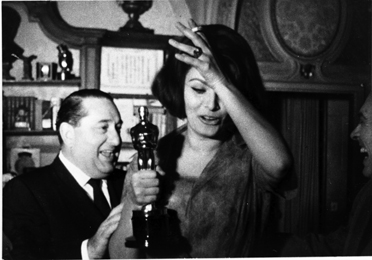
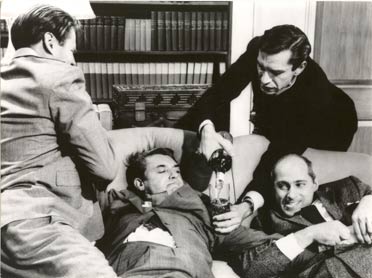
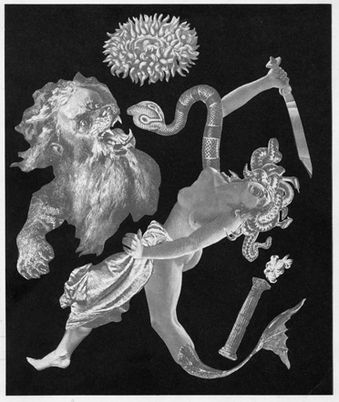
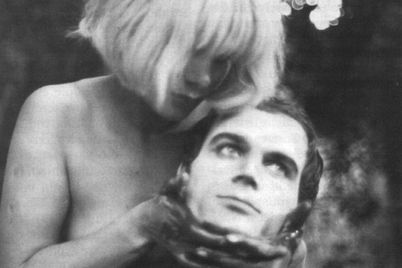
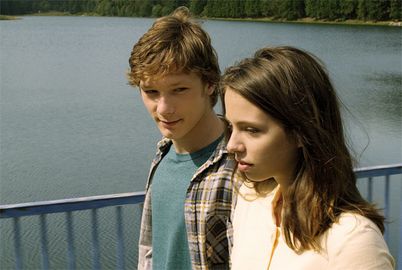
For this month's Living Archive public screening on March 14, we will be viewing Fernando Birri's ORG (Italy/Argentina 1978, 35mm, 177'). The film, starring Terence Hill, is considered as one of the most radical experimental films of all time. Birri himself classified it as his "dark opus magnum", which took him more than ten years to work on. The plot of the narrative portion of the film is partially based on Thomas Mann's "The Transposed Heads" which itself is based on Indian mythology.
New on realeyez.tv: "After Effect" & "Lifetimeshort"
We are very happy to present two new films on our VoD channel at realeyz.tv: AFTER EFFECT by Stephan Geene tells a love story trapped between art, cultural capital and marketing. LIFETIMESHORT by Gesine Danckwart is an entertaining, self-deprecating film about a day in the life of six women making yet another attempt to salvage their lives.
The following films are also still available for streaming on our VoD channel: Harun Farocki's TRANSMISSION (Germany, 2007), BULGARIA OF ALL PLACES (Germany/Bulgaria 2006) by Christo Bakalski, SUNNY LAND (Germany, South Africa 2010) by Aljoscha Weskott and Marietta Kesting, SUPER ART MARKET (Germany 2009) by Zoran Solomun and Angelika Levi’s films MEIN LEBEN TEIL 2 (Germany 2003) and ABSENT PRESENT (Spain, Senegal, Germany 2010).
On March 13, Ian White, participant of the Living Archive project, und Johannes Paul Raether and Johannes Paul Raether turn to the relationship between live performance and moving image at HAU1. Two performances have emerged from the artists' films in the Arsenal collection that dissect the theater space along the places proscenium, auditorium and stage. Johannes Paul Raether's witch Protektorama uses the stage as a mobile phone-television studio and produces a video of her ritual to save the world. Using Marx, Yvonne Rainer, Riki Kalbe, Maya Deren, the Divine Horsemen of Voodoo and Kinder eggs, she will prove to people how obsessed they are with the abstract principles of capitalism. In the auditorium, films by Karola Schlegelmilch, Klaus Telscher, Hellmuth Costard, Peter Weiss and Robyn Brentano / Andrew Horn that are connected to Walter Benjamin's notion about the origins of German tragic drama will be interspersed by performative activity by Ian White. A production of images that are not there but here.
This month's Jour Fixe: A Short History of Animal Cinema
This month's "What is Cinema?"-jour fixe on March 16 is all about animals: Animals in films free the gaze. This was clear in the first film in the history of cinema when a dog suddenly walked through the entrance gate between the workers leaving the factory. Animals have been turning up on screen in all sorts of ways since then, either randomly or as main protagonists in documentaries or features, experimental or animated films. Animals can serve to reawaken the interest of a viewer, either when a cat masters its role perfectly or Indian cows amid dense traffic impart a sense of complete calm. This program takes a little foray into film history and shows animals from different and often surprising angles. (Stefanie Schlüter) The program is aimed at schoolchildren in classes 1 to 6.
"Treeless Mountain"
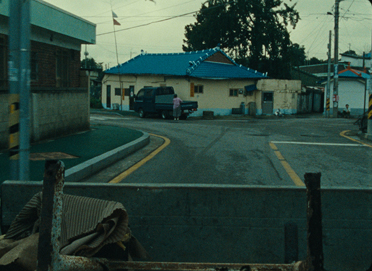
Jin, a bright-eyed six-year-old, lives with her mother and little sister, Bin, in a cramped apartment in Seoul, South Korea. When their mother decides to go look for their estranged father, Jin and Bin are forced to stay with their alcoholic Big Aunt for the summer. The girls are given a piggy bank with a promise from their mother that she will return when it is full. After their mother fails to return, Jin and her sister are forced to move to a farm owned by their grandparents. It is through this journey that Jin comes to learn the importance of family bonds. Inspired by her grandmother’s determination and hard work, Jin learns that taking care of her younger sister is actually a way of filling the hole in her heart.
New Works at ARTE Creative
Since last February, a selection of films from the arsenal distribution range has been available at ARTE Creative, an interactive platform that also encompasses experimental film and video work. Every month, a new arsenal distribution film is added to the channel, which is then available for streaming over a one-year period. Gheith Al-Amine’s ONCE UPON A SIDEWALK ist he latest addition to our channel. This video explores the representation of women as objects of desire and questions the medium of video itself by repeatedly manipulating its parameters. Geith Al-Amine’s works "T.S.T.L" and "King Lost His Tooth" were shown in the Forum Expanded programm of the 2012 Berlinale.
Out now: "Treeless Mountain"
So Yong Kim’s TREELESS MOUNTAIN is starting in selected cinemas on March 1. The film, which was shown in the 2009 Forum and has played successfully at many international festivals since, is being distributed by arsenal distribution. So Yong Kim's second feature length film (her third, FOR ELLEN, was shown in this year's Forum program) tells of Jin, a bright-eyed six-year-old, who lives with her mother and little sister, Bin, in Seoul, South Korea. When their mother decides to go look for their estranged father, Jin and Bin are forced to stay with their alcoholic Aunt for the summer. The girls are given a piggy bank with a promise from their mother that she will return when it is full. After their mother fails to return, Jin and her sister are forced to move to their grandparents. It is through this journey that Jin comes to learn the importance of family bonds.
This month, Gusztáv Hámos and Katja Pratschke present photo-films that examine memory and time and make us think of cinema. In LA JETÉE (Chris Marker, F 1962) the survivors of a nuclear war conduct time travel experiments with a prisoner. By remembering a particularly strong mental image, the face of a woman, the man manages to travel back in time and meet her. In (NOSTALGIA) (Hollis Frampton, USA 1971) a voice describes 13 photos. After a while, the pictures are burnt and transformed to ashes. Commentary and images are shifted tectonically. In FIASKO (Janet Riedel, K. Pratschke, G. Hámos, D 2010) Steinig, a survivor of Auschwitz, arrives in a hauntingly strange but also strangely familiar place, experiences déja-vu and gets caught in the maelstrom of a convoluted system (that of Stalinist Hungary). The film is told through split screen photography. (March 20, 7 pm).
Showcasing Sandrine Bonnaire
Sandrine Bonnaire is one of the most famous and popular French actresses of her generation. Since her debut in Maurice Pialat’s A NOS AMOURS (1983), she has worked with numerous auteurs and demonstrated her astounding versatility. With the generous support of the Institut français, Arsenal has been showing a comprehensive retrospective of her films since January.
Ulrike Ottinger's Berlin Trilogy
From February 26 to 29, we are showing Ulrike Ottinger's Berlin trilogy to wrap up our series on her work: BILDNIS EINER TRINKERIN - ALLER JAMAIS RETOUR (PORTRAIT OF A FEMALE DRUNKARD, 1979), FREAK ORLANDO (1981) and DORIAN GRAY IM SPIEGEL DER BOULEVARDPRESSE (THE IMAGE OF DORIAN GRAY IN THE YELLOW PRESS, 1984).
Funded by:
Arsenal on Location is funded by the Capital Cultural Fund
The international programs of Arsenal on Location are a cooperation with the Goethe-Institut