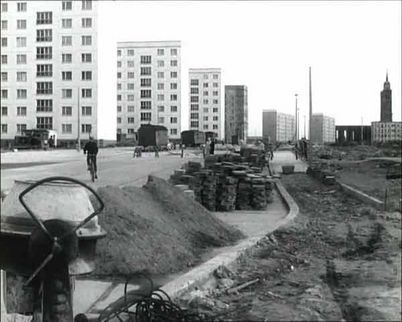
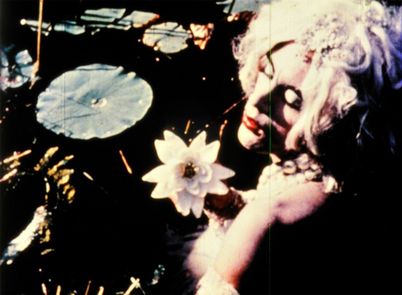
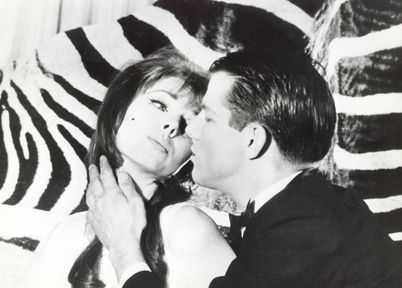
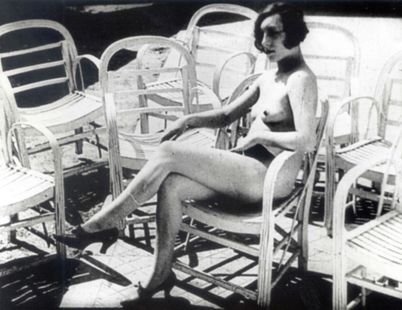
To coincide with Isabell Heimerdinger's "The New World Joy Garden" exhibition at the Galerie Mehdi Chouakri, we are showing a selection of her film works. Isabell Heimerdinger's art revolves around the phenomenon of film in a range of different ways – the language of film, those who play an active role in it, its recipients and its economic modes of operation are all up for discussion in her work. Heimerdinger makes use of such artistic strategies as reenactment, conceptual decomposition and sculptural setting. As such, her work doesn't just manage to explore the boundaries between cinematic fiction and "reality" in many different ways but also demonstrates the parallels between the worlds of film and art. (Raimar Stange) (July 15, Isabell Heimerdinger & Raimar Stange will be attending the screening)
Heide Breitel on her Birthday
Heide Breitel is about to turn 70. After fifty years in the “business”, filmportal.de lists a whole range of different professions for her: director, screenwriter, cinematographer, editor, sound manager, producer as well as “other”. She directed IM JAHR DER SCHLANGE (1981, July 16) to coincide with her 40th birthday, which draws up an initial balance of her life, containing reflections on a childhood spent in wartime and the confusion of flight, growing up subject to the narrow-minded ideas of the economic miracle period, breaking out and moving into the women’s movement in the 60s and 70s. From the point of view of today, the film is like a birthday present from her to us: a self-ironic look at both the life of women in 1981 and at German television at a time when the private was not yet being discussed to death in public and still retained political effectiveness. Heide Breitel’s films are part of the Deutschen Kinemathek’s archive holdings (Martin Koerber)
UdK Seminar: Film/Tape
The Cinematic Spaces program is being shown as part of a seminar on avant-garde film and tape music (Department for Sound Studies, UdK Berlin) which explores similarities and differences in artistic approaches within these two forms of media. Editing, material and time all form an integral part of both genres. The films chosen demonstrate cinematic space in exemplary fashion. Moving from the smallest element of film with respect to editing, the individual image (SERENE VELOCITY, Ernie Gehr, 1970), via the radical treatment of entire sequences of found film material (STADT IN FLAMMEN, Schmelzdahin, 1984), all the way to traversing space time in cinematic terms, where a lack of immediacy by no means leads to a drop in intensity. (WAVELENGTH, Michael Snow, 1967). (July 14) (Julius Stahl)
Guest: Doug Block
US documentary filmmaker Doug Block will be at Arsenal to present his last two films. 51 BIRCH STREET (USA 2005, July 17) What do adult children really know about their parents? And how much do they want to know anyway? This question presents itself in tangible fashion for Doug Block when, three months after his mother’s sudden death, his father announces that he is going to marry his old secretary and move with her to Florida. The parental house has to be cleared out and decades of memories grappled with, all at lighting speed. His picture of his parents and their marriage is fundamentally shaken up in the process. Block’s daughter Lucy is at the heart of his next film THE KIDS GROW UP (USA 2009, July 18). He has captured her life on film since her early childhood and has continued to train the camera on her as she grows up. But as Lucy gets old, she become increasingly uneasy at being constantly filmed and starts questioning his methods.
Berlin Premiere and Artist Talk – Andy Graydon’s VOSTOK, FARETHEEWELL
American artist Andy Graydon explores an “ecology of science fiction” in his work, specula-tive future imaginings of an area in motion. His most recent film VOSTOK, FARETHEEWELL (2011) reflects upon this experience in the city of Berlin, accompanying a Japanese tourist who has to design a model spaceship for a Korean science fiction film. We will also be showing his S8 travel film FARWANDERER (2003). A discussion with Andy Graydon will be held following the screening. (July 20)
Rising Stars Falling Stars – Presented by Vaginal Davis
In July, silent film star Vaginal Davis will be presenting Germaine Dulac’s THE SMILING MADAME BEUDET (La Souriante Madame Beudet, 1923), which can be seen as a fore-runner of an experimental and radically feminist cinema. The wife of an inconsiderate macho develops murderous fantasies. The film will receive a musical accompaniment by musicians John and Tim Blue. (July 29)
Once Upon A Time in the West (2) – The History of the Western Genre
Our Western series continues until the end of July, showing films from all the key phases of the genre. The Western is essential for an understanding of the American nation, for it is here that its foundation myths are reaffirmed and challenged on a constant basis, as the genre moves between the conflicting demands of historical fact and the need to create myths and legends. The crisis in 1960s America that arose from social tensions, the civil rights movement and the war in Vietnam is also reflected in the Western, with its heroes becoming insecure, melancholy and defeated. Finally, the Italo-Westerns and their opera-like, excessive staging ceased even to draw on reality anymore, taking their bearings instead from the Hollywood myths themselves.
Performing Documentary
Over the last ten years, a new, experimental variation on the documentary has emerged in Austrian and German filmmaking: films that work with explicit reenactments, obviously contrived situations, alienation effects and performative sequences to quite literally stage the documentary material that they are based upon. The "Performing Documentary" series brings together these documentaries and places them in a discursive context for the first time.
New in Cinemas: "Brownian Movement"
Nanouk Leopold's BROWNIAN MOVEMENT from this year's Forum programme is starting in selected cinemas on June 30. Main actress Sandra Hüller just received a special mention at the Festival des Deutschen Films.
This film by Sharon Sandusky (USA 1988) is the only one that we once screened for so long at Arsenal that the audience politely asked for a break. This was when the cinema was still in the Welserstraße, i.e. before 2000. We had already had to make a new copy three times by this point. We still love this 12-minute score in which lemmings run, fight, jump and swim while 1950s US teenage star Wayne Newton sings. This classic of found footage film exposes Walt Disney's collective lemming suicide myth. He was the one who shipped the animals to Alberta, Canada where he was shooting his film and pushed them over the cliff with a bulldozer. He apparently did not know they could swim and that they would survive, just as our 16-mm copy has. It could well be that we find a way of sneaking it back into our program some time soon.
Funded by:
Arsenal on Location is funded by the Capital Cultural Fund
The international programs of Arsenal on Location are a cooperation with the Goethe-Institut