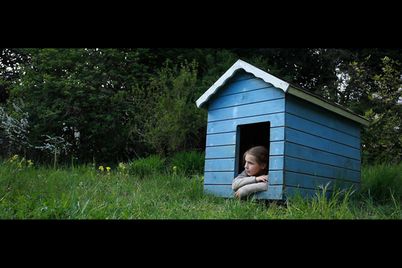
Jeannie and Lauren are twin sisters and share a house. Jeannie runs a secondhand store. She is afraid that her associate Amanda wants to sue her so she turns to her ex-boyfriend Merrill for advice, as he is just finishing his law degree. Lauren is on the look-out – for a job and for a steady boyfriend. She is about ready to go abroad as an English teacher.
"Aufnahme" ("Emergency Room")
In his multi-layered debut, the director – a former doctor himself – turns his attention to a Berlin hospital. Medical terms such as ward visits, doctor’s rounds, anamnesis, clinical patterns can also be applied to the film’s structure, which makes the institution appear like an organism being given a check up and prodded in various ways.
The DEFA Foundation presents
The DEFA Foundation's July screening program is dedicated both to actor Dieter Mann in honor of his 70th birthday as well as the big sporting event of the summer – the Women's Football World Cup that will be held in Germany this year. The film program begins with Hermann Zschoche's drama GLÜCK IM HINTERHAUS (Backhouse Bliss, GDR 1979). Dieter Mann plays librarian Karl Erp, who breaks out of his well-regulated family life to start an affair with a younger colleague. In the second part of the evening, it's all about the beautiful game: the documentary short FRAUEN AM BALL (Woman on the Ball, GDR 1987) creates a portrait of successful women's football team BSG Turbine Potsdam. In the musical comedy NICHT SCHUMMELN, LIEBLING! (No Cheating, Darling!, GDR 1972), the boys' and girls' football teams in the small town of Sonnenthal, which are led by the mayor and the school headmistress respectively, face-off in a bitterly fought contest. (June 6).
Alec Soth in "Somewhere to Disappear"
To coincide with the opening of the "Broken Manual" exhibition at the Loock Galerie (Halle am Wasser, Invalidenstraße 50/51, loock-galerie.de), which comprises photographs by Alec Soth, we will be screening SOMEWHERE TO DISAPPEAR (F 2010), a film which shows the American photographer at work. Filmmakers Laure Flammarion and Arnaud Uyttenhove follow him on a journey of over 30,000 kilometers right across the USA. For his "Broken Manual" project, he went looking for people who have decided to turn their back on society and live in solitude, whether in wooden huts in the mountains, in caves or even in the desert. Alec Soth uses a large-format camera to take photographic portraits of them. A film about men, America, Alex Soth and the dream of just disappearing. (June 10)
Special Guest: DAAD Fellow Alina Rudnizkaja
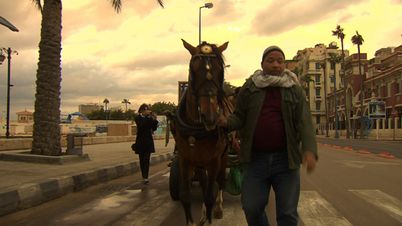
Alina Rudnizkaja (born 1976) works for the renowned St. Petersburg Documentary Film Studios and is currently a guest of the DAAD Berlin Artists-In-Residence program. Her multi-award winning documentaries are dedicated to exploring everyday life in the "new" Russia and show a society in upheaval. COMMUNAL RESIDENCE (2002) provides insight into the Soviet concept of shared housing. AMAZONS (2003) is concerned with a group of urban Amazons, who keep horses in the middle of St. Petersburg and do not tolerate any man amongst their ranks. With a subtle feel for humor, CIVIL STATUS (2005) collects scenes from a registry office, where papers for married couples, the recently divorced and the bereaved are all issued with the same stoic expression. In VIXEN ACADEMY (2008), a group of young women attend a course in order to learn how to seduce, marry and control men. Behind their often absurd efforts, the personal and social motives for their actions shine through. (June 9)
Once Upon a Time in the West The History of the Western Genre
For a long period, the Western was unquestionably one of the most important Hollywood genres, with Westerns making up one quarter of all films produced in Hollywood between 1910 and 1960. Film history and the history of the Western are thus linked in a unique way. "The Western is situated at a point of intersection where historiography and mythologization, actual occurrences and mass media interpretations, meet and flow into one another." (Alexandra Seitz)
Filmdokument
Before live television reporting became the standard, the short sport reports in the newsreels were the only opportunity for large audiences to take part in sporting highlights. It’s therefore no surprise that the newsreels themselves were responsible for producing feature-length films about outstanding sporting events. HINEIN! DEUTSCHE FUSSBALL-MEISTERSCHAFT 1950 (Go For It! The 1950 German Football Championships, Walter Rohde, West Germany 1950) documents the championship final between VFB Stuttgart and Kickers Offenbach held at the Berlin Olympic Stadium on June 25 1950. The film is more than just a football report, however, as it creates a portrait of the players, all of whom worked in other professionals at the time. It also observes the construction workers at the Olympic Stadium and takes the viewer in a stroll down Kurfürstendamm. A document from a time when football was not yet completely commercialized. (Jeanpaul Goergen).
Films from arsenal distribution and Forum Expanded on ARTE Creative
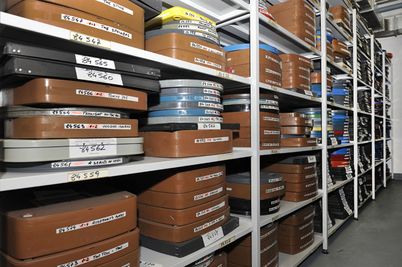
Since this February, a selection of films from the arsenal distribution range has been available at ARTE Creative, an interactive platform that also encompasses experimental film and video work. Every month, a new arsenal distribution film is added to the channel, which is then available for streaming over a one-year period. Keren Cytter’s film DER SPIEGEL (Germany 2007, 4') is the latest new addition to our arte Creative channel, while DER FATER (Germany 1986, 26') by Christine Noll Brinckmann, Marie Losier’s TONY CONRAD DREAMINIMALIST (USA 2008, 26', English original version), Ayse Erkmen’s COFFEE (Turkey 2007, 25') - which was first shown in the Forum Expanded section of the 2008 Berlinale – and Phil Collin’s SOY MI MADRE are all still available for streaming. Further films and videos from the arsenal distribution range will be added over the next few months.
FU Seminar: Surrealism
As a place for the imagination, the cinema provided the best pre-requisites for the surrealists' aim of drawing upon the unconscious. In the two most well-known surrealist films UN CHIEN ANDALOU (1929, June 14) und L'ÂGE D'OR (1930, June 14), Luis Buñuel and Salvador Dalí create a series of highly unconventional associations by using montage to bring together elements seemingly alien to one another, an strategy much in keeping with the ideas in the head of surrealist André Breton. Both films make use of shock tactics, with the razor blade that cuts through an eyeball in the prologue of UN CHIEN ANDALOU becoming infamous. Marcel Duchamp’s hypnotic rotoreliefs can also be seen as an attack on the predominance of the eye and are on display in Hans Richter's DREAMS THAT MONEY CAN BUY (1947, June 28) accompanied by music by John Cage. Richter brought together his old avant-garde companions for this episodic film, which was produced in the America after the Second World War; as such, in addition to Duchamp, Max Ernst, Man Ray and Fernand Léger were also involved in the film. Both of the programs will be shown as a part of the FU seminar on Surrealism. (Jürgen Dehm)
FU Seminar: Nazis, Humor, Holocaust
The "Nazis, Humor, Holocaust" film studies seminar at the FU Berlin explores different humorous perspectives on the 2nd World War, National Socialism and the Holocaust in film. The highly contentious combination of humor and genuine horror, which come into conflict again and again here, are of central interest.
The European auteur cinema of 70s is known for its general tendency to make humor itself the object of subversion rather than just employing it for subversive means. An example of this approach can be found in Rainer Werner Fassbinder's DESPAIR (Germany 1978). Comedy and National Socialism find correlation here in a haunting manner, with the evocation of absurdity and ridiculousness finding no release in liberating laughter. The increasingly apparent symbols of National Socialism are superimposed on to the paranoia of the protagonist. (Naomi Rolef) (June 16)
Funded by:
Arsenal on Location is funded by the Capital Cultural Fund
The international programs of Arsenal on Location are a cooperation with the Goethe-Institut