Jump directly to the page contents

Trip to Stromboli, October 2024

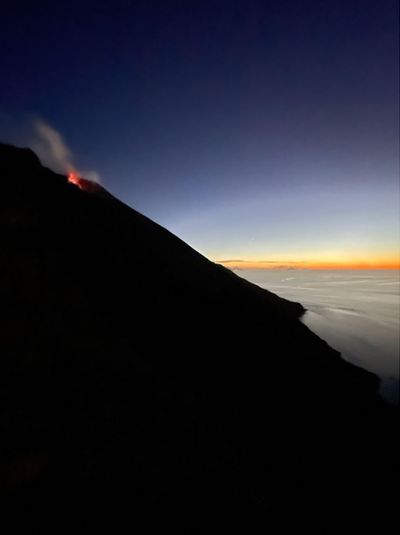
One of the things that most inspired this project – not only FANFICTIE: VOLCANOLOGY but the FANFICTIE trilogy as a whole – was a trip I made to Stromboli last October at the invitation of Almanac. I had often heard Indonesian volcanologists speak of “Strombolian” eruptions and of the ancient volcanic islet Strombolicchio. Confronted with these two entities – climbing Stromboli with a back aching beyond belief and swimming, utterly terrified, around Strombolicchio – I realised that humans cannot make sense of nature through sensory experience and rational knowledge alone. There is something else, something greater, though to this day I cannot say what it is – a decidedly Kantian moment.
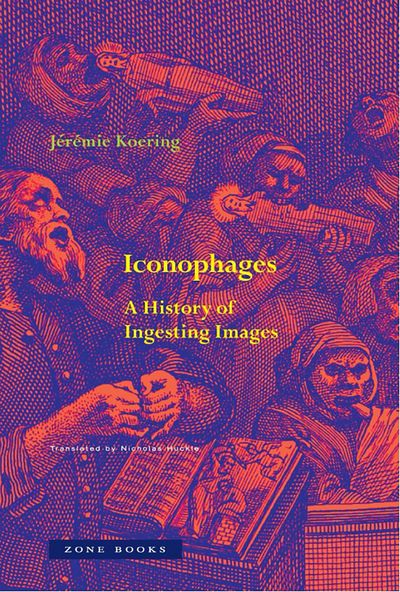
Iconophages: A History of Ingesting Images by Jérémie Koering (2024) 

I read this book while in Stromboli. It prompted many reflections on volcanoes and symbolism in the context of Javanese culture in Indonesia. Volcanoes are reproduced as images in almost every aspect of life, which led me to wonder what it would mean to consume such images – as a metaphor for becoming-one, for the fusion of volcano and human. That said, the book largely centres on the relationship between iconophagy and the Judeo-Christian heritage in the West. In this context, exploring iconophagy within Islamic traditions is challenging, given the continuing prevalence of iconoclasm in various schools of thought. While the book does look back to certain ancient practices – such as those in Egypt (Horus the Child) – the motivation behind most acts of iconophagy remains the channelling of spiritual desire and the pursuit of healing. Nevertheless, the notion of iconophagy – and the metabolic fusion between images, nature and the (human) body – forms a fundamental strand of this project.

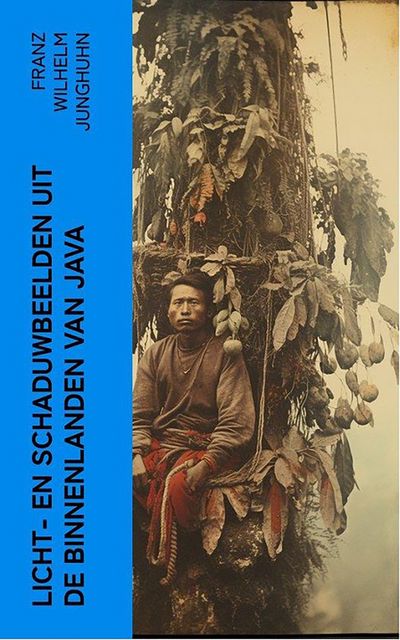
Licht- en Schaduwbeelden uit de Binnenlanden van Java (Images of Light and Shadow from Java’s Interior) by Franz Wilhelm Junghuhn (1862)

Franz Wilhelm Junghuhn (1853–1855) is a central figure in my work FANFICTIE: VOLCANOLOGY. This is his most controversial book, and it's a theory-fiction. He presents his ideas on attaining unity with nature while describing the Javanese landscape through the eyes of a colonial scientist. In this work, he appears as a modest materialist and firm determinist, as well as a monist openly committed to the advancement of science and enlightenment. In several passages he even anticipates the concept of entropy, speculating that the number of atoms never changes and that an individual’s consciousness simply transforms into other forms of matter. Although critical of Christianity, Junghuhn seems reluctant to dispense entirely with the idea of God; he views it through the lens of emanation theory – there is a divine origin, but everything thereafter is governed by natural law. The reflections voiced through his characters encapsulate a strikingly anomalous way of thinking for a scientist working in Java and Sumatra at that time. This forms the core of my current project. I’m reading the Indonesian edition, translated with lyrical precision by the geologist Muhammad Malik Ar Rahiem.

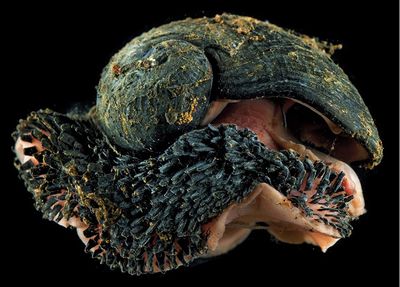
A specimen of Chrysomallon squamiferum photographed alive (Photo: David Shale)

This is an image of the scaly-foot snail (Chrysomallon squamiferum), a species that lives on active submarine volcanoes in the Indian Ocean and has a shell – and parts of its foot – made of iron. When I first saw this photograph, I returned to an idea put forward by my favourite sci-fi writer, Peter Watts: that evolution is not “survival of the fittest” but “survival of the most adequate” – what is most feasible rather than universally perfect. I developed this idea in FANFICTIE: VOLCANOLOGY, proposing that, within colonial volcanology in the Dutch East Indies, the aim was to create conditions in which one could endure the relentless force of nature. It was a replication of how people living for millennia in colonised lands managed to survive earthquakes, eruptions and other forms of natural brutality. Looking at this volcano snail also led me to reflect on Junghuhn’s obsession with becoming one with the volcano – perhaps he, too, needed to grow a skin of iron.

Back to installation

Funded by:

  • Logo Minister of State for Culture and the Media