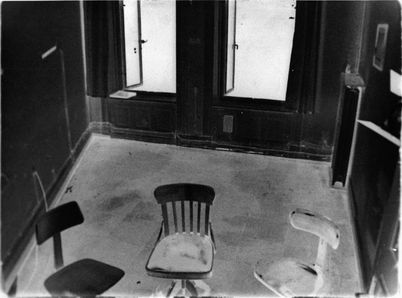
DAY OF THE SPARROW (Philip Scheffner, D 2010) is a political nature film in which the border between war and peace is dissolved. On November 14, 2005, a sparrow is shot after having toppled 23,000 dominos in the Dutch town of Leeuwarden. In Kabul, a German soldier is killed in a suicide attack. The juxtaposition of these headlines prompted the director to search for war using the methods of ornithology. In Germany, not Afghanistan. For this is where the question arises: Are we living in peace or are we at war?
Premiere: KRATZIG & Classics Not Only For Children
KRATZIG 1 – 3 and SCRATCH (2010, April 25) are the titles of four films on 16 mm, 35 mm and DVD that schoolchildren of the Hunsrück-Grundschule and the Evangelische Schule Berlin Zentrum produced in three workshops by means of manual scratching, painting, anima-tion and sound. We are delighted to present the films in the presence of the young filmmakers and the workshop and project heads, Ute Aurand, Robert Beavers, Dirk Schaefer, and Stefanie Schlüter, at Arsenal. All workshops were supported by funds of the Berliner Projektfonds Kulturelle Bildung.
FilmDokument: Auto-Kino
Since entering the market, the Volkswagen production plant in Wolfsburg has continuously made an effort to bring moving images of the production process in its factory halls to the movie theaters. This program presents a selection of corporate films that were commissioned by Volkswagen during the years of the economic miracle in Germany and that focus on the production of the automobile sold throughout the world. The time-related cross-section allows drawing exciting comparisons: What filmic motifs were at the fore immediately after the end of the war, once car-making was resumed? How did the content and shape of the cinematic images of series production change during the course of the "long 1950s"?
The DEFA-Stiftung presents
The DEFA-Stiftung starts its monthly film series with the following double program: In her documentary VERDAMMT, ICH BIN ERWACHSEN – DER DEFA-REGISSEUR ROLF LOSANSKY (D 2009, premiere, April 12, as guests: Dagmar Seume, Rolf Losansky), director Dagmar Seume portrays the successful DEFA director of children's and youth's films, Rolf Losansky. From 1963 on, he shot more than 20 films for children and youths that today count as classics. In encounters with fellow travelers and in the confrontation with his films and archival material, the film retraces decisive biographical, theoretical and historical moments.
Magical History Tour – Voice, Language, Speaking in Film
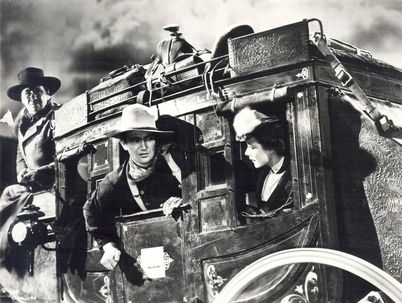
In April we invite visitors of the Magical History Tour to lend an ear. At issue in this month's – as always subjective – selection is less the big topic of sound (which we will deal with in the future) but three pivotal and oftentimes neglected elements of the audio track: the voice, language and speaking in film. The audible voice in conjunction with the image of the actor in film counted as one of the fundamental innovations of sound film and in some cases soon became an existential problem. Many voices failed to meet the audience's expectations: For example, the British accent of English actors was met by laughter in the United States, the rough voice of Greta Garbo at first alienated the spectators, and the twang of John Gilbert was completely rejected. These early responses by the audience already refer to the high status that the voice (and, derived from it, language and speaking) has in relation to the image in film. But not only the acoustic features, the tone of the actors’ voices and their alleged "harmonious" unity with the cinematic image refer to the power of the voice in cinema, but also such moments in which voices and language resist the images, in which both elements diverge and becomes detached from each other. In many of the films presented this month, the formal tensional relationship becomes a basic module and the starting point of the plot.
16th Jewish Film Festival Berlin & Potsdam 2010
Unusual, surprising, amusing, and pensive insights into Jewish life around the world is what the 23 films of the 16th Jewish Film Festival promise. The festival will take place from the end of April to the beginning of May in Berlin and Potsdam, again under the reliable direction of Nicola Galliner.
filmPOLSKA 2010 – Camera Art
The cameramen Sławomir Idziak (born 1945) and Marcin Koszałka (born 1970) are at the fore of our homage within the frame of the festival of Polish cinema in Berlin, filmPOLSKA. In films and discussions we would like to give an impression of the wide range of creative work of the two DoPs.
Romy Schneider
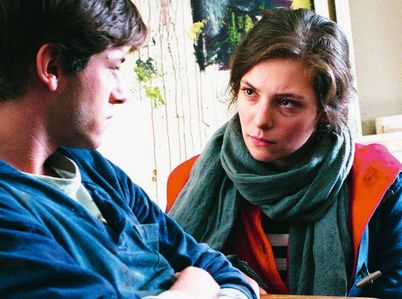
In the 1970s, Romy Schneider has established herself once and for all as a serious actress. She broke away from light entertainment cinema, left her origins behind, lived permanently in France, and henceforth grasped herself as a French actress. After LA PISCINE (1968), which led to the breakthrough she longed for, she did her first film in 1969 with Claude Sautet, who was to become her most important director alongside Luchino Visconti. She shot five movies with him, in which she was able to realize all the facets of her skills as an actress and that belong to the highlights of her career. From the 1970s until her early death in 1982, she was a star in France, where she pre-dominantly worked. With LUDWIG II made by Luchino Visconti in 1972, she destroyed the romantic Sissi image once and for all by playing the Empress of Austria as a cold and aloof woman.
In No Man's Land – The Films of Lisandro Alonso
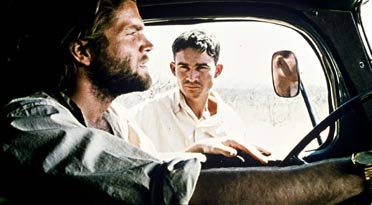
The young Argentine filmmaker Lisandro Alonso (* 1975) is currently one of the stars of world cinema and counts as a significant formal innovator in the present film landscape. His idiosyncratic films are met by enthusiasm at international festivals, but are almost unknown in Germany since there is until now no distributor. Against this background, Arsenal shows commitment in a twofold way: It will showcase four films by Lisandro Alonso, and additionally distribute Alonso's most recent film LIVERPOOL via arsenal distribution, thus making it permanently available to national movie theaters.
Vaginal Davis presents Rising Stars, Falling Stars
WHAT 80 MILLION WOMEN WANT (USA 1913) was inspired by the women's suffrage movement. As politics work to deny women the right to vote, a young lawyer tells his activist girlfriend of the corruption within the government that actively seeks to ensure that her voice is never heard. The film is introduced by silent movie expert Vaginal Davis and accompagnied with live music by John and Tim Blue. After the screening Ms. Davis invites audiences to drinks in the Red Foyer. (30.3.)
Funded by:
Arsenal on Location is funded by the Capital Cultural Fund
The international programs of Arsenal on Location are a cooperation with the Goethe-Institut