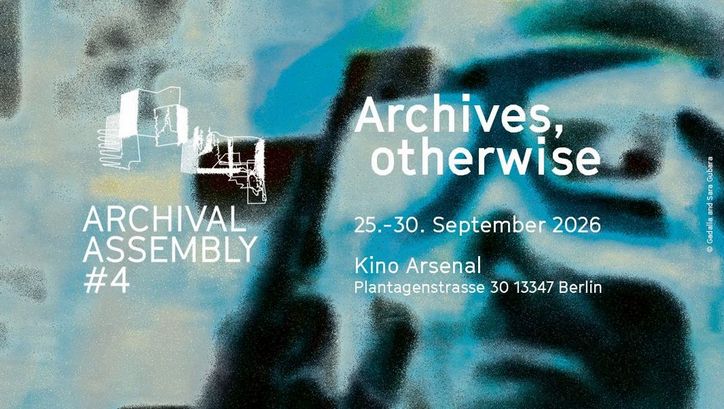
Archival Assembly #4 – Archives, otherwise

The 4th edition of the Archival Assembly festival will be taking place at the new Arsenal cinema for the first time. Restorations, new films, installations, and project presentations are woven into a symposium that invites participants to rethink the concept of film heritage in light of the present.
Archives, otherwise is an invitation to view film heritage as an imagined legacy. Through its international programming at the Arsenal cinema and the Forum, the Arsenal archive houses films from many countries around the world. This distinguishes it from state archives, whose mission is to preserve their respective national film heritages. If we consider all the films in the Arsenal archive as a whole, what would their legacy actually be? What connects them? They all once sought to do something new, something different—in terms of content, aesthetics, or form. From this, countless connections can be drawn, enabling new conceptions of film heritage that are also significant for regional and national film archives.
The German word “Erbe” combines the meanings of heritage, inheritance and inheritor. Who inherits what from whom and to what purpose? For over 200 years, the prevailing answer has been that citizens of a nation-state inherit material objects (including those that have been appropriated) and intangible practices from earlier generations, which are handed down via tradition and institutions such as museums and festivals in order to foster a sense of a shared past and future. Cultural heritage thus creates a form of imagined kinship that connects generations across time and space—a kinship that European nation-states in the 19th century sought to naturalize through language, ethnicity, and territory in order to assert belonging and exclude the other.
But what if this connection is not taken for granted, but rather understood as something that can be reestablished time and again? Arsenal is explicitly committed to returning cinematic heritage from countries of the “Global South”—which in many cases has been lost or is inaccessible—back to those regions. Yet imaginary communities of heritage are emerging all over the world through engagement with similar themes and realms of experience. In times of resurgent ethno-nationalism and new imperial ambitions, a critical perspective on film heritage as an imaginary legacy opens up new spaces for thinking about forms of world-building and archival practice beyond nation-state citizenship. Archival Assembly #4 – Archives, otherwise examines archives and archival practices that give shape to alternative answers to the question of what is inherited by whom, how and for what purpose in order to productively reinvent relationships of kinship.
The symposium thus opens with the London-based project UNREST, which addresses issues of restitution and access while exploring forms of archiving and circulation that transcend nation-state frameworks. The Zurich-based project “Paranational Cinema—Legacies and Practices” will serve as the closing panel, introducing the term “paranational” to describe cinematic and archival practices that transcend the category of the nation-state.
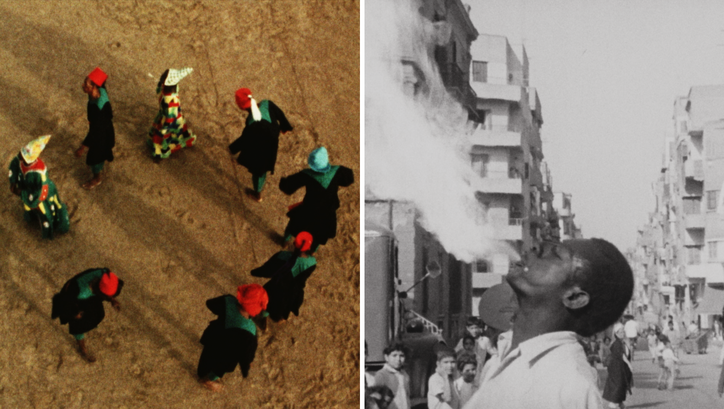
We open the festival with the restoration of KADDU BEYKAT (Letter from My Village, Senegal 1975) by Safi Faye, which premiered in Locarno in August. Other new restorations include films by Hussein Shariffe, Atteyat Al Abnoudy, Flora Gomes and Christine and Kurt Rosenthal. New works by Angela Melitopoulos and Kerstin Schroedinger, Rosa Barba, Anastasiia Bergalevich and Ebimoboere Ibinabo will also be shown. In addition, the festival offers insights into archival projects, solidarity networks and technologies of cinematic kinship.
Program brochure
We owe the fact that Archival Assembly can take place once again to our broad network and the solidarity it has shown. Our main partners are Goethe University Frankfurt/Main, the Cinémathèque suisse, and the Goethe-Institut, which offers a unique residency program: nine AA#4 participants will be in Berlin starting in August: Drika de Oliveira (Rio de Janeiro), Lilia Ben Achour (Tunis), Touda Bouanani (Rabat), Petna Ndaliko Katondolo (Goma), Didi Cheeka (Lagos), Wua-Ling Wu (Taiwan), Jere Ikongio (Berlin), Samuel Bich (Berlin) and Beatrice Zerbato (Palermo). Other partners include the Johannes Gutenberg University Mainz, King’s College London and the University of Zurich. Archival Assembly #4 is supported by the German Research Foundation (DFG) and the DAAD’s TNB-STEP program. (Stefanie Schulte Strathaus/Vinzenz Hediger)
All events take place at Arsenal Cinema. Access to the festival is possible with a festival pass (50 €, 40 € reduced, 35 €, members including the evening program) or daily tickets (15 €, 12 € reduced, 10 € members, including the evening program). Access to the film screenings in the evening is possible by purchasing a regular cinema ticket. The festival pass and daily tickets are available exclusively at the Arsenal box office.








Funded by: